In the current landscape – gospel need, challenges and opportunity – Yarnton is seeking to change the culture around training through enabling and funding
Changing the culture through enabling training
Enable gospel partnership among evangelical Anglicans, Independents and Others around a uniting focus on multiplying gospel workers
Align with groups like ReNew, CEEC and the Alliance, to work for a future for evangelical Anglicans in and outside the Church of England
Promote the importance of gospel work and appreciation of its worth
Build consensus and collaboration among training stakeholders around training vision, culture and strategy
Work with church leaders and future leaders to change the culture, so that training and sending gospel workers is an essential and normal part of the missional strategy of every local church, in partnership with external training providers
Train the trainers
Engage in research to describe healthy training culture in local churches
Critical factor is local churches training
Local churches and networks of churches embracing their responsibility for training and sending out gospel workers, in partnership with external training providers
Local churches developing a healthy training and sending culture
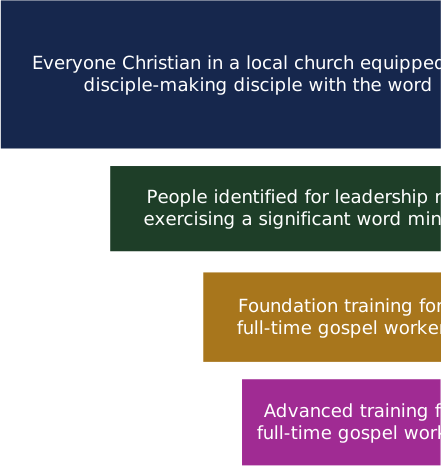
A local church with a healthy training and sending culture is where everyone is equipped to be a disciple-making-disciple with the word
Some will be identified as suitable for leadership roles exercising a significant word ministry
Some of them will be identified to be trained and deployed as full-time gospel workers to serve in local churches, exercising a significant word ministry
Foundation training for full-time gospel workers
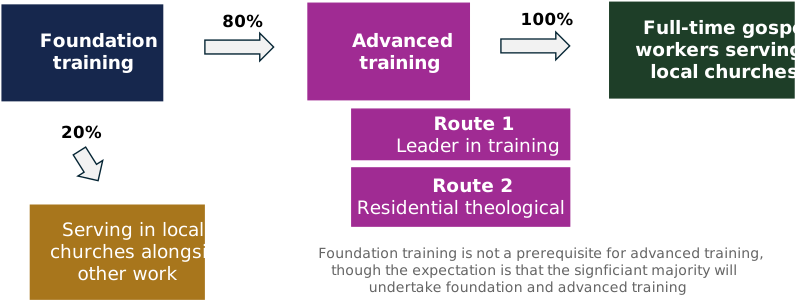
Foundation training is full-time in a local church for 2 years, in partnership with an external training provider
In exceptional circumstances, part-time in a local church for 2 years or full-time for 1 year, in partnership with an external training provider
In many churches, foundation training will be an Apprenticeship, Associate, Internship or Ministry Trainee programme
The external training provider could be a Gospel Partnership training course or a portfolio of distance-learning courses like Union’s Grow programme
Foundation training is with the intention and expectation that the significant majority will go on to become full-time workers in local churches. We are setting a notional target of 80%
Currently, some Apprenticeship or Associate programmes in churches have that expectation, but many don’t. Research on training culture in local churches has found that these two types of programme are very different, in terms of who is recruited, the expectations of trainers and those being trained, the content of the programme, and the church’s level of investment in the programme. While both types of programme are valuable, Yarnton will partner with churches whose foundation training programmes are focused on preparing people for full-time gospel work
Advanced training for full-time gospel workers
There are two routes for advanced training:
Route 1 - Leader in Training
A Leader in Training role (also referred to as Pastor in Training, Minister in Training or Trainee Christian Leader) in one or more local churches for 3 or 4 years in partnership with an external training provider
The terminology Leader in Training embraces men and women, reflecting complementarian principles
Route 2 - Residential theological study
Training in the context of residential theological study
Training pathways for full-time gospel workers